What will 2012 Usher in the Financial Markets?
The stock market's 17-month drop into March 2009 erased all the gains in the Dow Jones Industrial Average since the late 1990s. That's a full decade's worth of gains.
And the two-week drop that ended August 9 basically wiped out all the gains from 2010 - 2011.
Just since August 1, there have been over 25 days that the Dow closed more than 200 points above or below its previous close. That's volatility.
What does this all mean for the markets and your portfolio? Is another downturn ahead or is it finally a buying opportunity?
Elliott Wave International has just released a free report that will help you navigate the year ahead. You'll get all of the indicators that they have been analyzing over the past year, with 25 eye-opening charts and 14 pages of straightforward commentary.
This could be the most important investment report you'll read for 2012.
Download your free report now.
Free Commodity Trade Analysis
Elliott Wave International has just announced the beginning of their popular commodity FreeWeek event, where non-subscribers can test-drive some of their most popular premium services.
Now through noon Thursday, October 27 (Eastern time), you'll get complete access to all of EWI's most-promising daily, weekly and monthly opportunities in the world's leading commodities, plus all the charts, world-class analysis, video forecasts along with a treasure chest of trading lessons and more! (Subscribers normally pay $49/month for these services.)
Learn more and get instant access to EWI's FreeWeek of commodity forecasts and trading education now -- before the opportunity ends for good.
FreeWeek is one of EWI's most popular programs, and it's perfect for anyone curious about EWI's subscription services. Please don't hesitate to tell your friends about the exciting opportunity FreeWeek provides.
Why is the Stock Market Falling?
Earnings was good. European debt problem has always been there while the market marched up. S&P credit rating downgrade of the US government was not a surprise. But the market has been going down and down relentlessly for the last month. What happened? The answer may shock you: News, events and earnings do not drive stocks! So, what does? To understand what drives the stock market, you need to join us at ElliotWave.com - Download the 33-page Market Myths Exposed eBook now. And to have an idea about where the market is going, make sure to read the free stock market report:
Credit Crisis in Europe
Europe's debt crisis began in Greece then leaked into Ireland -- but it won't stop there, warns a new report from Elliott Wave International's European analyst Brian Whitmer.
Whitmer first alerted his subscribers to the still-developing European crisis back in December 2009, when he warned that a set of troubling events across Europe were signaling the entire continent was on edge. Then in February, when the modern-day Greek tragedy appeared to be contained by all media accounts, our friends at EWI anticipated yet another wave of debt woes across Europe. Here's what Whitmer wrote on Feb. 26:
- "Greece's woes aren't over, and neither are its neighbors, meaning that more surprises are sure to come."
Whitmer has been anticipating and tracking the growing debt crisis in Greece, Ireland Spain, Portugal and other European nations. His analysis is so valuable and so timely right now that EWI has decided to give you their latest paid analysis on Europe in a new free report, " Credit Crisis in Europe: How the Stability of an Entire Region is Teetering on the Edge of a Major Collapse."
Even if you don't invest in Europe, developments in these European countries can have a big impact on your portfolio. This explosive 6-page report helps you prepare for the crisis in Europe, and it's jam-packed with forecasts and analysis originally published for EWI's paying subscribers. For the REAL story on Europe -- independent from media assumptions and conjecture -- read this prescient new report from EWI.
Download your free report, "Credit Crisis in Europe: How the Stability of an Entire Region is Teetering on the Edge of a Major Collapse."
Still Enough Time to "Conquer the Crash?"
Why a New York Times Bestseller Remains Relevant Now
"If you were fortunate enough to have read the first edition of Robert Prechter's Conquer the Crash, your money was safe and sound as stocks, real estate, commodities and many bonds plummeted." Conquer the Crash, 2nd edition, (quote from inside book sleeve)
The New York Times bestseller Conquer the Crash published in 2002: As the quote above suggests, Bob Prechter advised readers to avoid risky assets and embrace cash and cash equivalents.
But did the 2007-2009 declines represent all of the bear market? And is the "Great Recession" over?
Many financial commentators believe the answer to both questions is "yes." The latest Elliott Wave Theorist reports on attitudes toward the rally of the past two years:
- "...sentiment measures today do not indicate caution, skepticism and disbelief but rather multi-year extremes in optimism among five sets of market players: individual investors, futures traders, options traders, newsletter advisors and mutual fund managers."
Regarding the economic outlook, the March Elliott Wave Financial Forecast notes a recent business story headline which reads, "Good Times Ahead." The story quotes a top banker saying, "Businesses have plenty of capital and are starting to expand again."
The same issue of the Financial Forecast also reminded subscribers that the fear of inflation remains widespread:
- "When Fed Chairman Ben Bernanke touched on the 'politically volatile subject of inflation' in [recent] Congressional testimony, the blogosphere erupted with proclamations about runaway prices across the board. Here's one sample, 'There can be only one possible result. Inflation of everything we use is going to explode.'"
Yet Robert Prechter has another perspective on market optimism, a business climate "turnaround," and notions of runaway inflation. That is why he updated the second edition of Conquer the Crash to include 188 new pages.
These new pages include "updated lists of banks, insurers and Treasury-only money market funds in the U.S., top-rated for safety."
More than ever, Prechter emphasizes safety. In a word, it's the key to conquering a severe market downturn. Follow the advice about safety in CTC, 2nd edition, and you'll be better prepared for a deflationary depression.
Elliott Wave International has put together a FREE, 8-lesson report based on Conquer the Crash, 2nd edition. This free, 42-page report can help you prepare for the future -- financially and economically!
Why not read "8-Lesson: Conquer the Crash Collection"? It's FREE!
Become a member of Club EWI (membership is also free), and you'll have immediate access to "8 Lesson: Conquer the Crash Collection." Just follow this link and you're on your way to financial peace of mind.
Market Myths Exposed - Free Download
You’ve no doubt heard the old mantras: “stocks for the long haul,” “diversify,” “buy and hold.”
Investment gurus worldwide repeat them daily. But are these strategies really wise for ALL markets? Can advice that sounds so simple (but so vague) be useful to you as an investor?
Anyone who diversified their portfolios across several stocks, bonds and commodities over the past three years knows that diversification is no foolproof way to profit. The same goes for individuals who decided to buy and hold the S&P index 10 years ago, they're barely at breakeven, even after the recent rally. Many individual stocks have never come back from the drop in 2008-2009.
During the mania - when the trend was almost always up - virtually anything had a good chance to go higher. Investors ignored advice that cautioned against risk, because there was always someone lucking into a moon shot during the insanity. The S&P index itself – followed by the NASDAQ and other markets – sat at the center of the mania. Back then, simply being in an index often outperformed other popular strategies. That's not the case any more.
Our friends over at Elliott Wave International have just released an ebook to help you recognize and avoid bad investment advice forever. EWI's 33-page Market Myths Exposed eBook takes the 10 most dangerous investment myths head on and exposes the truth about each one in a way every investor can understand.
You will uncover important myths about the safety of your bank deposits, earnings reports, investing in bubbles, small stocks, inflation and deflation, speculation and more.
Download the 33-page Market Myths Exposed eBook now.
The Next Major Disaster Developing for Bond Holders
If you have money in mutual funds, Treasury bonds, municipal bonds or high-yield bonds, Robert Prechter has just issued a crystal-clear warning for you: Your money could be at risk.
Prechter, the famed market forecaster who specializes in Elliott wave analysis, sent similar warnings about the Nasdaq in 2000, real estate in 2006, the blue chips in 2007 and commodities in 2008. His forecasts proved deadly accurate.
In trademark fashion, Prechter now has his readers focused on something most mainstream investors, analysts and advisors are taking for granted: the safety and stability of the bond market.
Why worry about the safety of bonds, you ask? A recent USA Today article reported that investors put a "record-shattering" net $376 billion into bond mutual funds in 2009, and individual investors and mutual funds are "still showing the love" in 2010.
After such explosive growth, Prechter says bond investors have been pushed to the edge of a mile-high cliff. Millions of investors are just one step away from tumbling over the edge.
If your hard-earned savings are exposed to the developing risks in these markets, you owe it to yourself to heed Prechter's urgent warning.
Download your free 10-page report: The Next Major Disaster Developing for Bond Holders.
ETF Trading Alerts
Elliott Wave International’s Wayne Stough adds another Flash opportunity service to the line-up: ETFs
Every trader or active investor at times wishes they could pick the brain of a pro that has "pulled the trigger" on real-money trades before.
EWI Director of Analysis Wayne Stough is one of these pros. For several years, several times per month, he's been alerting his Flash service subscribers to opportunities in futures markets.
And now, there is a new addition to the Flash service line-up: ETF Opportunity Flash. We caught up with Wayne in his office and asked him a few questions:
What method do you use when looking for high-probability trade set-ups?
Wayne Stough: My main approach is The Elliott Wave Principle. I look for clean, precise wave counts - usually ones that other analysts can confirm, so there is a general consensus on market direction. Once the market meets my other criteria for a high-confidence trade, I send out a Flash recommendation to my subscribers.
How do you define a "high-confidence" trade?
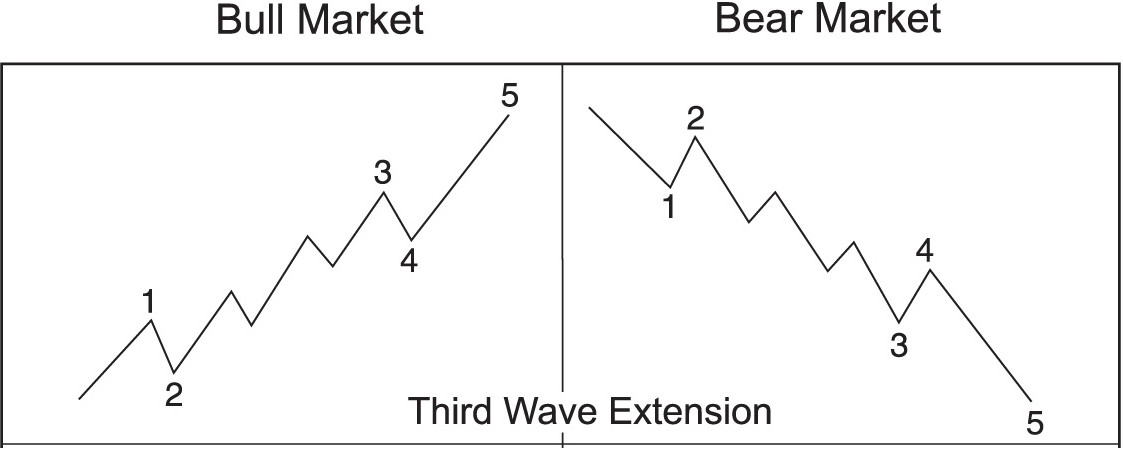
That's a good question, because no market forecast is ever guaranteed, whether you use Elliott or some other forecasting method. Having said that, there are definitely moments when probabilities (or odds, if you will) strongly suggest a particular move. For example -- and this is just basic Elliott -- the Wave Principle says that markets move in a series of five waves in the direction of the larger trend (labeled on a chart 1, 2, 3, 4, 5) and three waves against the trend (labeled A, B, C). Also, there are certain proportions between these waves that markets often adhere to. So whether I'm counting a 1, 2, 3, 4, 5 pattern in a rally or a decline (i.e., in a bull or bear market), I focus on where the fifth wave should end, according to Elliott wave guidelines.
Once I've identified that price termination point, it becomes a matter of waiting for the market to get there. Fifth waves come at the end of the pattern and are usually weaker than third waves. So once I see certain technical indicators diverging (e.g. the RSI), my confidence grows: We are near the end of the pattern, and prices are about to reverse. That's just one example of a high-confidence situation. But I do suggest a protective stop with every new Flash alert, in case the forecast doesn't come true.
Are you aiming for a particular percentage gain?
Absolutely. When I send a Flash alert, I'm typically looking for a 3-to-1 ratio, at a minimum.
Does that always work out?
No. I monitor the recommendation for warning signals that let me know when a different scenario is unfolding in the charts. In those cases, I send out another Flash alert suggesting to lower or raise the stop-loss level, or exit the recommendation entirely.
They say you love the S&P Mini as a trading vehicle. Why?
I'd put it differently. I have traded the S&P for a long time, I understand that market's nuances, and I like the leverage and volatility. But while the S&P comes naturally to me, I've also made many Flash recommendations on other markets, like gold and currencies. So, a better way would be to say that I love any market that gives me the desired risk-reward ratio. Now I'm also "looking for love" among various ETFs.
Special Introductory Offer: Sign up for ETF Opportunity Flash now and have 2nd month FREE. Get details here.
If traders expect a bear market, should they still consider Flash Services?
Absolutely. I think we're at the cusp of something very big in the stock market. And this is the time to act. Just keep in mind that speculating in severe bear markets (or during extreme volatility) carries additional risks. So be sure you do your research and know how your financial instruments behave under these conditions. And anyone who chooses to trade in this environment must only risk the money they absolutely can afford to lose.
Who do you think should consider subscribing to EWI's Flash Services -- including the newest addition, the ETF Flash?
Anyone who has some risk capital but not enough time or experience to find their own opportunities. Anyone who understands and accepts the fact that when you bet your money, there will be winners and losers. (Sometimes more of one than the other.) Anyone who knows better than to risk all their capital on a single recommendation; the old "all eggs in one basket" situation. I think in terms of quarters: I want all my subscribers smiling at the end of a quarter.
Elliott Wave International’s ETF Opportunity Flash service now brings you potential high-probability opportunities in exchange-traded funds (ETFs). Don't miss this special offer.
Technial Analysis Handbook - Free Download
Today more and more investors are warming to the fact that psychology moves markets and therefore fundamental analysis, which fails to properly measure mass investor psychology, must be flawed.
Who can blame them? After all, fundamental analysis - based on past company earnings, rating agency projections and the like - proved to be of little value during the bust.
But there is a better way.
Many investors who monitor investor sentiment readings, study Elliott wave patterns and employ other powerful technical indicators were, at very least, able to position themselves to survive the recent decline. Still others were able to turn crisis into opportunity and profit from the volatility. How did they do it?
Technical analysis.
Stock market technical indicators remove the cloudy, bias-driven assumptions from your analysis and focus on the one thing that moves markets: investor psychology.
Past performance is not indicative of future results and that's where fundamental analysis goes wrong. It fails to factor in the psychology that not only moves markets up and down but also leads analysts to extrapolate the current or past trend into the future. That's why fundamental analysts almost always miss major tops and bottoms.
Our friends over at Elliott Wave International employ the largest team of technical analysts in the world. They recognize that optimism peaks before market tops and pessimism troughs before market bottoms. They use powerful and sometimes unconventional tools to help identify psychological extremes that signal high-probability turning points.
EWI's brand-new 50 page eBook, The Ultimate Technical Analysis Handbook, will show you the various methods of technical analysis they use every day and teach you how to use these powerful tools for yourself.
If you're a technician, this eBook is perfect for you. If you're a fundamentals follower, it's more important than ever that you give technical analysis a closer look. Even if you never completely abandoned your fundamental indicators, you WILL benefit from understanding these valuable technical tools.
Download NOW! This valuable eBook is now offered for FREE!
Independent Investor eBook- Free Download
Dear Investor,
The old adage says, "you are what you eat," and today we're offering you a heaping portion of brain food.
At long last, the mainstream media is beginning to question buy-and-hold investing – it's a myth that EWI's original Independent Investor eBook debunked years ago. Even the "Efficient Market Hypothesis" has come under fire from the Oracle of Omaha himself – the Independent Investor long ago exposed EMH for the fantasy it is. Now that the mainstream has finally caught up to these myths, the Independent Investor eBook can once again put you ahead of the herd; you can understand truths today that the mainstream will catch up to someday in the future.
You'll get the most groundbreaking and eye-opening reports ever published in Elliott Wave International's 30-year history, PLUS 6 brand-new chapters (43 new pages) of specific analysis, forecasts and commentary that will help you think independently in today's tumultuous market. Tens of thousands read the first Independent Investor, but even many of them will miss out on the important new advice the new, greatly expanded eBook imparts. Put yourself ahead of the herd for years to come – get a copy of the new 118-page Independent Investor eBook today.
Download the New Independent Investor eBook now. It's FREE download.
The Report FED Does Not Want You to Read
Elliott Wave International have just released a free 34-page eBook, Understanding the Fed. It’s the free report the Federal Reserve doesn’t want you to read!
This eye-opening free report, which represents more than 10 years of research by Robert Prechter, goes beyond the Fed's history and government mandate; it digs into the Fed's real motivations for being the United States' "lender of last resort." In this 34-page report, you'll discover how the Fed's actions, combined with public outrage, may ultimately lead to its demise, plus much more about its secret activities and how it affects your money.
Download your free copy of EWIs Understanding the Fed eBook, here. It's FREE download.
|